
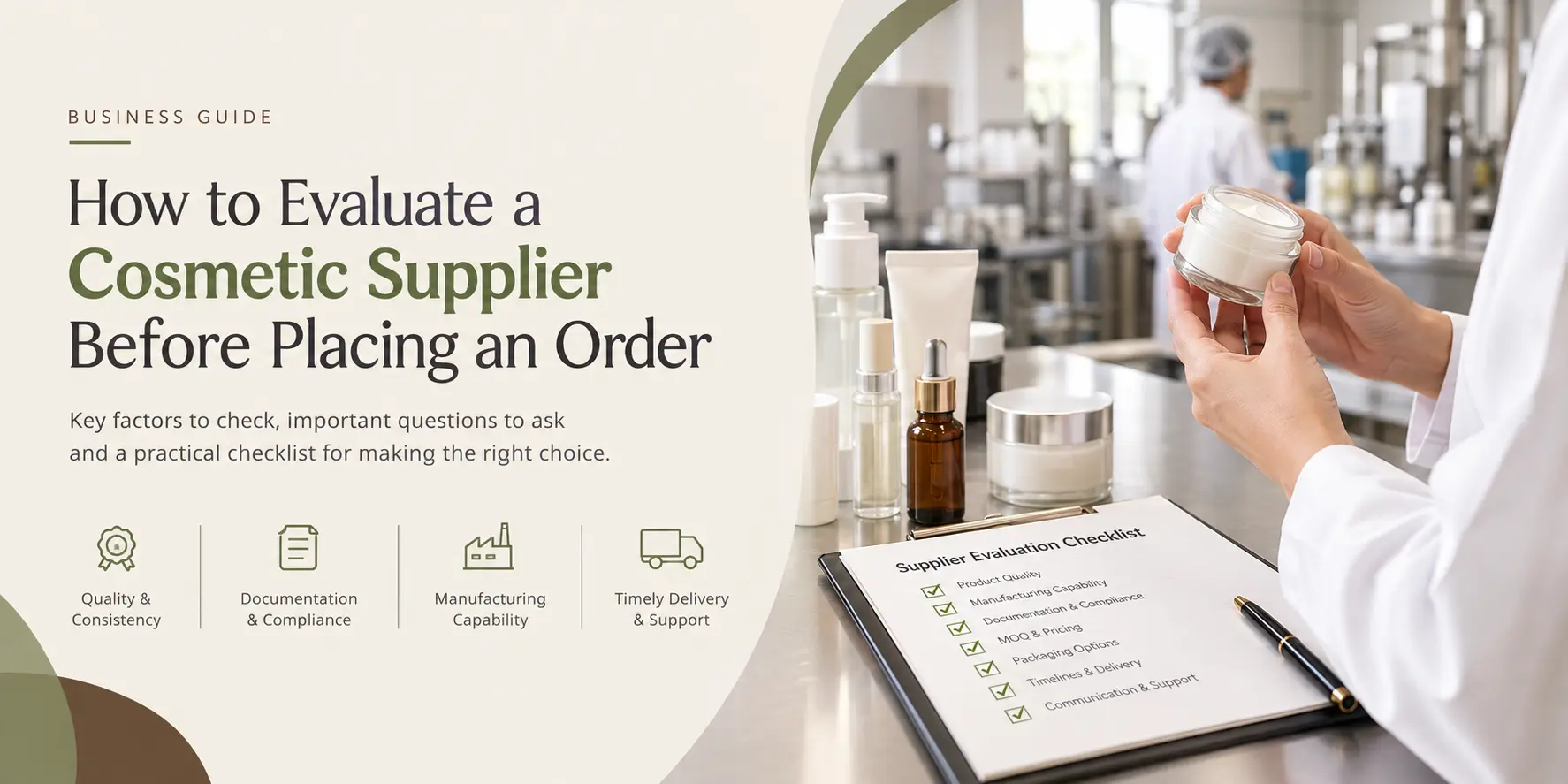
How to Evaluate a Cosmetic Supplier Before Placing an Order?
Choosing the right cosmetic supplier is one of the most important decisions a beauty brand can make. The supplier you select can directly affect your product quality, consistency, packaging, costs, timelines, regulatory readiness, and ultimately your relationship with customers.
A professional supplier should offer more than a product catalogue and an attractive price. Before placing an order, you need to evaluate whether the supplier can consistently deliver the right product, specifications, documentation, packaging, quantity, and support your business requires.
Whether you are launching a new skincare brand, expanding an existing personal care range, sourcing private-label products, or purchasing cosmetics for distribution, the following checklist can help you evaluate a supplier more confidently.
1. Start With Your Own Product Requirements
Before evaluating suppliers, clearly define what you actually need.
A supplier can only be properly evaluated when your requirements are specific. Prepare a basic product brief covering:
- Product category
- Product type
- Intended market
- Target customer
- Desired formulation or product specifications
- Key ingredients or actives
- Texture and appearance
- Fragrance requirements
- Packaging format
- Pack size
- Expected quantity
- Label requirements
- Required documentation
- Target delivery timeline
- Private-label or custom-branding requirements
For example, instead of simply asking for a “face serum,” your requirement could specify a particular active ingredient, concentration, texture, packaging format, quantity, and target market.
The clearer your requirement, the easier it becomes to compare suppliers accurately.
2. Check the Supplier’s Manufacturing Capability
One of the first questions to ask is whether the supplier actually has the manufacturing capability required for your product.
A supplier may offer hundreds of products, but that does not necessarily mean every product is manufactured under the same setup or process.
Ask about:
- Manufacturing facilities
- Product categories handled
- Formulation and R&D capabilities
- Production capacity
- Quality-control processes
- Packaging capabilities
- Batch manufacturing process
- Experience with similar products
- Ability to handle repeat production
If you require a custom formulation, this becomes even more important.
A supplier with an experienced formulation and product-development team can help translate your product concept into a practical formulation instead of simply offering an existing catalogue formula.
Why this matters
Your first order may be small, but if the product performs well in the market, you may need larger quantities later. Therefore, evaluate whether the supplier can support your brand beyond the first order.
3. Request Product Samples Before Bulk Production
Never evaluate a cosmetic supplier based only on photographs, product descriptions, or promises.
Whenever possible, request a sample before committing to bulk production.
A sample allows you to evaluate the actual product rather than relying on assumptions.
Depending on the product, evaluate:
- Texture
- Colour
- Fragrance
- Appearance
- Spreadability
- Absorption
- Product consistency
- Packaging quality
- Overall user experience
- Performance against your specifications
For skincare and personal care products, the sensory experience can be particularly important because customers interact directly with the product.
Don’t evaluate only one sample
If the project is important or involves a custom formulation, you may need to go through multiple sample-development rounds.
The objective is not simply to receive a sample. The objective is to determine whether the supplier can consistently develop and reproduce the product you need.
4. Compare the Sample With Your Requirements
Receiving a sample is only the first step.
You should evaluate the sample against the original product brief.
Create a simple evaluation sheet covering:
| Evaluation Area | What to Check |
|---|---|
| Appearance | Colour, clarity, uniformity |
| Texture | Thickness, spreadability, feel |
| Fragrance | Strength and suitability |
| Application | Ease of application |
| Performance | Expected product behaviour |
| Packaging | Quality, compatibility and usability |
| Labelling | Required information and presentation |
| Specifications | Whether agreed requirements are met |
If the supplier provided specific specifications, compare the sample against those specifications rather than judging the product only by personal preference.
5. Understand the MOQ Clearly
Minimum Order Quantity, or MOQ, is an important commercial consideration.
However, don’t look at MOQ in isolation.
Ask what the MOQ actually applies to:
- Finished product
- Packaging
- Printed labels
- Custom formulation
- Individual SKU
- Total order quantity
Some suppliers may have different MOQs depending on the packaging selected, formulation requirements, customization, or production process.
Ask these questions
Before placing an order, clarify:
What is the minimum quantity per SKU?
Does the MOQ change with different packaging?
Is the MOQ different for custom formulations?
Can multiple products be combined into one order?
Understanding these details prevents unexpected changes in your initial quotation.
6. Evaluate Product Quality and Consistency
A good supplier should not only produce a good first batch. They should be capable of producing consistent batches over time.
This is particularly important for brands that expect repeat orders.
Ask how the supplier manages:
- Raw material quality
- Batch-to-batch consistency
- Manufacturing controls
- Product testing
- Quality checks
- Finished-product inspection
- Storage conditions
- Traceability
If you are building a long-term brand, consistency can be more valuable than simply finding the cheapest supplier.
A product that performs differently from one batch to another can create customer complaints, returns, and damage to brand reputation.
7. Ask About Quality-Control Procedures
A professional cosmetic supplier should have defined quality-control procedures throughout the manufacturing process.
Depending on the product and manufacturing arrangement, this can include checks on:
- Raw materials
- Production stages
- Bulk product
- Finished product
- Packaging components
- Batch details
- Microbiological parameters where applicable
- Physical and chemical characteristics where applicable
Ask the supplier how quality is monitored and what documentation is available for the products you are purchasing.
You don’t necessarily need to demand every possible document from every supplier. Instead, determine which quality and compliance documentation is relevant to your specific product and target market.
8. Review Available Documentation
Documentation is an important part of supplier evaluation, particularly for B2B cosmetic sourcing and international markets.
Depending on the product, destination market, and business arrangement, relevant documentation may include:
- Product specifications
- Ingredient information
- Certificate of Analysis (COA)
- Safety-related documentation where applicable
- Product test reports
- Stability information where applicable
- Manufacturing information
- Batch documentation
- Packaging specifications
- Label information
- Export documentation
The exact documentation required can vary according to the product and destination country.
Don’t assume documentation is automatically included
Ask the supplier:
“Which documents will be provided with the product, and which documents are available upon request?”
Clarifying this before the order helps avoid problems later.
9. Evaluate Regulatory and Compliance Support
If you are selling cosmetics in another country, regulatory requirements become even more important.
A supplier should be able to communicate clearly about the documentation and information available for your target market.
Depending on your destination, you may need to consider:
- Ingredient restrictions
- Product claims
- Labelling requirements
- Responsible-person or importer requirements
- Product information documentation
- Safety assessment requirements
- Batch traceability
- Testing requirements
- Import documentation
A supplier does not necessarily replace your regulatory consultant or importer. However, an experienced manufacturing partner should be able to provide accurate product and manufacturing information needed for the compliance process.
10. Check Packaging Capabilities
Packaging is not simply about making the product look attractive.
The packaging must also be suitable for the product, filling process, storage conditions, transportation, and target market.
Evaluate:
- Bottles
- Jars
- Tubes
- Pumps
- Droppers
- Sprayers
- Sachets
- Outer cartons
- Labels
- Closures
- Printing options
Also ask whether the supplier can source packaging or whether you need to arrange it separately.
Packaging compatibility matters
For example, a formulation may require a specific dispensing system or packaging material. Your supplier should be able to discuss practical compatibility considerations rather than treating packaging as a completely separate issue.
11. Understand Customization Options
If you are building a private-label brand, determine how much customization the supplier actually offers.
Customization may include:
- Existing formula selection
- Fragrance selection
- Colour adjustment
- Texture adjustment
- Active ingredient changes
- Custom formulation
- Packaging selection
- Label design coordination
- Outer-carton customization
- Product claims based on formulation and testing
There is an important difference between private-label customization and true custom formulation.
Private label generally involves selecting or adapting an existing product for your brand.
Custom formulation involves developing or modifying the formulation according to your specific product requirements.
Make sure you understand which model your supplier is offering.
12. Evaluate Communication and Responsiveness
Communication is often overlooked when comparing suppliers.
However, it becomes extremely important once an order moves into formulation, packaging, production, and dispatch.
Pay attention to:
- How quickly they respond
- Whether answers are clear
- Whether they understand your requirements
- Whether they provide complete quotations
- Whether they communicate changes promptly
- Whether they explain limitations honestly
- Whether they provide realistic timelines
A supplier who communicates clearly during the enquiry stage is generally easier to work with during production.
Don’t judge communication only by speed
A fast reply is not necessarily a good reply.
Look for accurate, complete, and commercially useful communication.
13. Ask for a Clear Cost Breakdown
Price should certainly be considered, but it should not be the only deciding factor.
A lower initial quotation may not necessarily represent the lower overall cost.
Clarify what your quotation includes:
- Product manufacturing
- Raw materials
- Packaging
- Labels
- Printing
- Filling
- Outer cartons
- Testing
- Documentation
- Shipping
- Taxes
- Other applicable charges
Also ask whether there are separate charges for:
- Samples
- Custom formulation
- Artwork
- Packaging development
- Special testing
- Custom moulds
- Small production runs
A transparent quotation makes supplier comparison much easier.
14. Check Production and Delivery Timelines
Before placing an order, understand the expected timeline from approval to dispatch.
The total timeline may include:
Product approval → Packaging approval → Artwork approval → Raw material procurement → Production → Filling → Labelling → Quality checks → Packing → Dispatch
Ask your supplier:
- What is the expected production lead time?
- Does the timeline start after advance payment?
- Does it begin after artwork approval?
- What happens if packaging is delayed?
- How are production delays communicated?
- What is the expected dispatch timeline?
Avoid suppliers who give unrealistic delivery commitments simply to win an order.
15. Evaluate Order and Payment Terms
Before confirming your purchase, make sure the commercial terms are documented.
Review:
- Payment schedule
- Advance payment requirements
- Balance payment
- Production start conditions
- Cancellation terms
- Sample charges
- Packaging charges
- Shipping responsibility
- Taxes and duties
- Delivery terms
For larger B2B orders, ensure that the agreed specifications and commercial terms are clearly documented in the quotation, purchase order, proforma invoice, agreement, or other relevant documentation.
16. Check the Supplier’s Ability to Handle Repeat Orders
A supplier should be evaluated not just for your first order but for your potential future requirements.
Ask yourself:
“If this product becomes successful, can this supplier support my next 5–10 orders?”
Consider:
- Production capacity
- Raw material sourcing
- Packaging availability
- Batch consistency
- Lead times
- Communication
- Documentation
- Pricing stability
- Ability to add new SKUs
A supplier that can grow with your business can become a valuable long-term manufacturing partner.
17. Evaluate Export Experience if You Sell Internationally
For international buyers, supplier evaluation should go beyond product manufacturing.
If you are importing cosmetics, ask whether the supplier has experience handling export orders and international documentation.
Relevant areas may include:
- Export packaging
- Commercial invoices
- Packing lists
- Shipping documentation
- Product documentation
- Customs-related paperwork
- Freight coordination
- Destination-market requirements
- International shipment experience
Export experience does not automatically mean that every regulatory requirement in your country is covered. You should still confirm the responsibilities of the manufacturer, importer, distributor, and regulatory representative.
18. Look for Transparency Rather Than Big Promises
Be cautious of suppliers that make broad claims without providing practical information.
For example, instead of focusing only on statements such as:
- “Best quality”
- “Lowest price”
- “Fastest delivery”
- “100% guaranteed”
look for evidence and specifics.
Ask:
What quality checks are performed?
What documentation is available?
What is the actual MOQ?
What is the production timeline?
What happens during sample development?
What exactly is included in the quotation?
Professional suppliers should be comfortable answering practical questions.
19. Common Red Flags to Watch For
Before placing an order, be cautious if a supplier:
Avoids providing product samples
If they expect you to commit to a significant bulk order without allowing appropriate product evaluation, ask why.
Gives unclear pricing
If the quotation doesn’t clearly explain what is included, request clarification before proceeding.
Cannot explain their manufacturing process
You don’t need confidential manufacturing formulas, but the supplier should be able to explain the relevant production and quality process at a reasonable level.
Makes unrealistic promises
Extremely low prices, unusually short production timelines, or guaranteed results without supporting information should be treated carefully.
Changes specifications frequently
If the agreed formulation, packaging, quantity, or commercial terms keep changing without proper communication, reconsider the supplier.
Provides incomplete documentation
For regulated products and international orders, missing or unclear documentation can create problems later.
Has poor communication after receiving payment
Your supplier’s responsiveness should not disappear once the order is confirmed.
20. Create a Supplier Evaluation Checklist
Before making your final decision, score each supplier across important areas.
| Evaluation Factor | Supplier A | Supplier B | Supplier C |
|---|---|---|---|
| Product Quality | ✓ | ✓ | ✓ |
| Sample Evaluation | ✓ | ✓ | — |
| Manufacturing Capability | ✓ | ✓ | ✓ |
| Custom Formulation | ✓ | — | ✓ |
| MOQ | ✓ | ✓ | ✓ |
| Packaging Options | ✓ | ✓ | ✓ |
| Documentation | ✓ | ✓ | — |
| Compliance Support | ✓ | — | ✓ |
| Communication | ✓ | ✓ | — |
| Production Timeline | ✓ | ✓ | ✓ |
| Export Support | ✓ | — | ✓ |
| Pricing Transparency | ✓ | ✓ | — |
| Repeat-Order Capability | ✓ | ✓ | ✓ |
The objective isn’t necessarily to find the supplier with the lowest price.
The objective is to identify the supplier that provides the best overall fit for your product, market, quality expectations, commercial requirements, and long-term plans.
21. Don’t Choose a Cosmetic Supplier on Price Alone
Price is important, but it should be evaluated alongside the complete supply proposition.
Consider:
Product quality + consistency + MOQ + packaging + documentation + communication + lead time + customization + compliance support + scalability
A supplier offering a slightly higher price may provide significantly better product development, quality control, packaging support, documentation, and communication.
For a growing beauty brand, those factors can have a much greater impact on the business than saving a small amount on the initial purchase price.
Final Checklist Before Placing Your Order
Before confirming your order, make sure you can answer yes to the following:
- Have I evaluated the actual product sample?
- Does the sample meet my product requirements?
- Is the formulation or specification clearly documented?
- Is the MOQ clearly understood?
- Is the packaging finalized?
- Is the packaging suitable for the product?
- Are the required documents available?
- Are regulatory responsibilities clear?
- Is the quotation transparent?
- Are payment terms documented?
- Is the production timeline realistic?
- Does the supplier have the required manufacturing capability?
- Can the supplier handle repeat orders?
- Is communication clear and professional?
- If exporting, are shipping and export responsibilities understood?
If several of these questions remain unanswered, it may be better to clarify them before placing the order rather than discovering the problem after production has started.
Conclusion
Choosing a cosmetic supplier is not simply about finding a product at the right price. It is about finding a manufacturing or supply partner that can consistently meet your product, quality, packaging, documentation, commercial, and delivery requirements.
Start with your product requirements, request and evaluate samples, verify manufacturing capabilities, understand MOQ and pricing, review documentation, assess communication, and confirm production and delivery terms before committing to bulk production.
For brands planning to build a long-term product range, the right supplier should be capable of supporting not just your first order, but your future product development, repeat manufacturing, packaging requirements, and business growth.
A careful supplier evaluation today can help prevent costly production and quality issues later.